Teaching the daily newsroom course at TMU (JRN851/Masthead/OTR) has prompted more than a few ideas for research avenues. I started with the Newsroom Notes workshops, wherein I invited guest speakers to fill in the gaps our students self-reported in their own education. Topics for Newsroom Notes included everything from how to break into photojournalism to how to deal with microaggressions in the newsroom to the ethics of using AI in journalistic work.
That was my introduction to SoTL research (Scholarship of Teaching and Learning), so I published my Newsroom Notes research in Facts & Frictions, and took on a new SoTL project to explore how my students were using AI tools in my newsroom course and perhaps measuring the mindfulness of that usage.
In F2024, I started talking about the ethics of using AI tools in my student newsroom, and I added a simple boilerplate message to the bottom of all the articles in an effort of transparency with our audience:



Phase I
For F2025, I worked with the TMU Research Ethics Board again to incorporate the research project into a classroom setting with the following research questions.
RQ1. How does embedding an AI-disclosure field within a course-based publishing workflow influence students’ awareness of their AI use?
RQ2. How do user-experience (UX) design choices in an AI-disclosure field shape students’ ethical reasoning and reflective practice regarding AI use?
RQ3. How does sustained engagement with AI disclosure practices influence students’ perceptions of professional responsibility, authorship, and disciplinary norms in journalism?
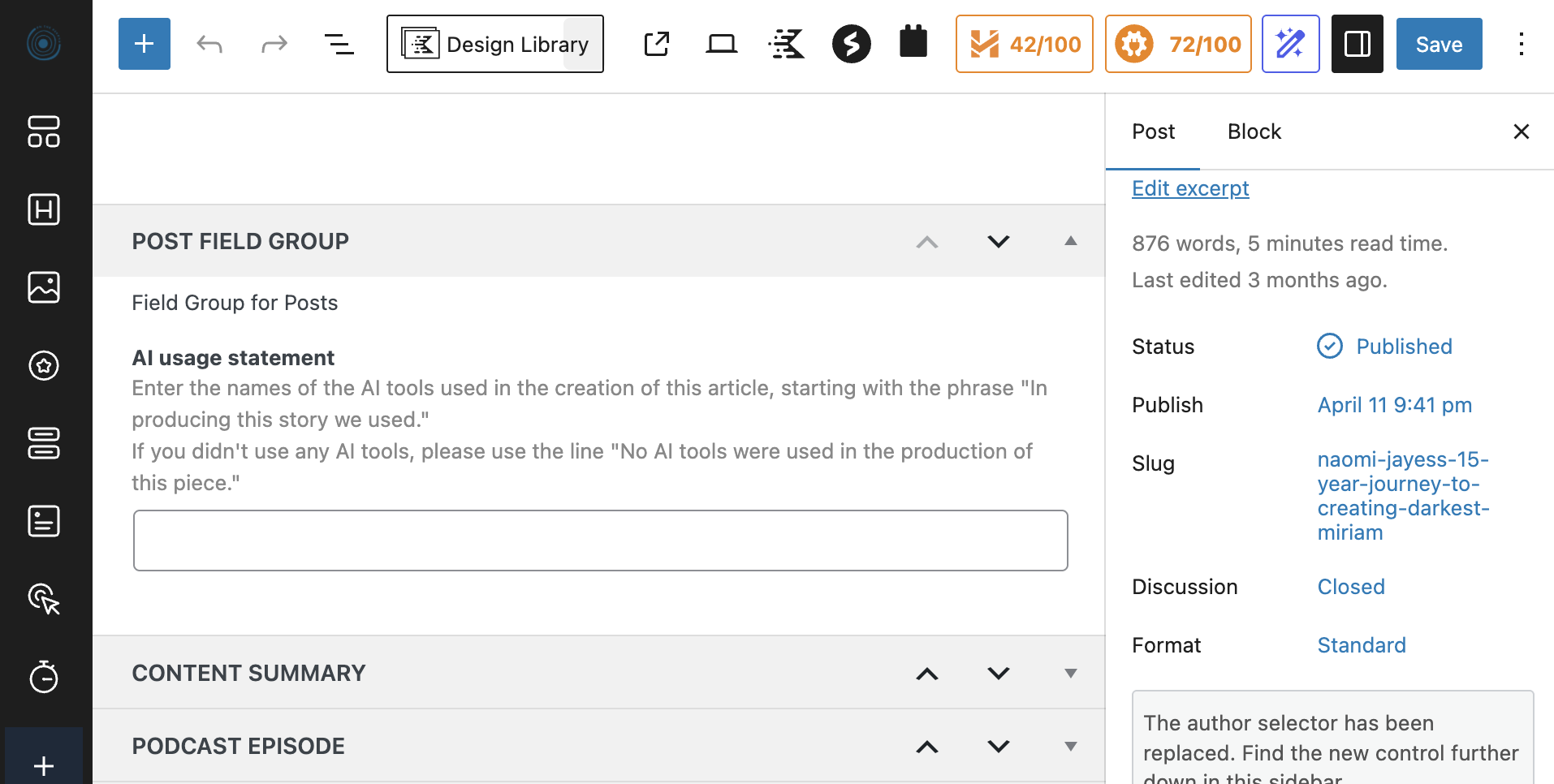
I designed an artifact in the form of an AI disclosure field in the CMS (WordPress) of the course that my students would need to fill out for every new story they produced.
The text in this field appears at the bottom of the story and is specific in the use of AI tools for that story, which is a more accurate form of transparency with the audience.
I also added a 5-question survey measuring the students’ awareness and feelings towards using AI tools to create journalism. I ran the survey with the students on the first day of classes and again on the last day of classes to see if anything changed after a semester of talking openly about AI and transparently revealing that usage on the website.
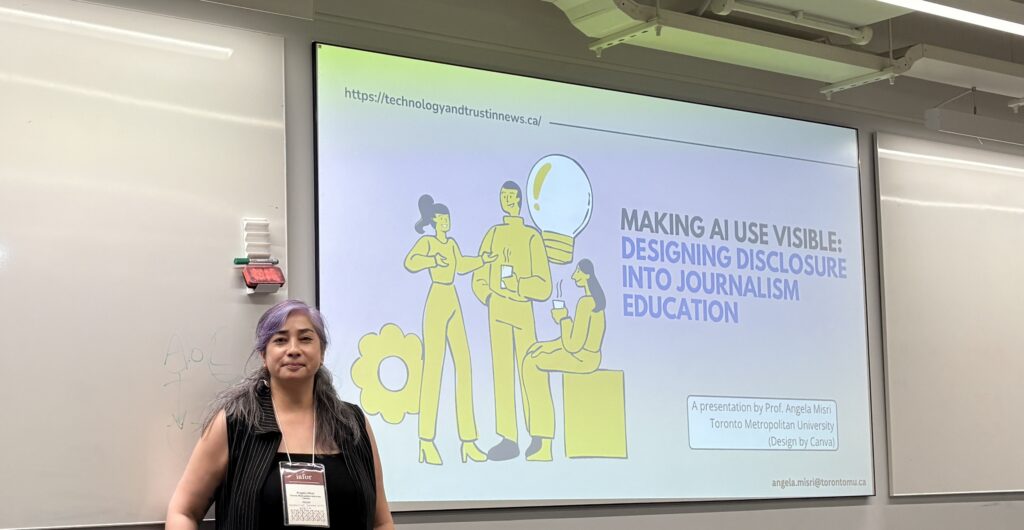
The findings from this pilot project were presented at the 2026 TrentSoTL Symposium in February and at the AEJMC Southeast Colloquium in March, and I presented the final paper at the ECE Conference in London in July.
I have two potential outputs for this first phase: a chapter in a book and an academic paper.
The chapter will focus on the AI disclosure as more than a transparency mechanism; it functions as pedagogical infrastructure that shapes professional identity, ethical reflexivity, and authorship in new/emerging journalists.
The journal paper will go through all the data I’ve gathered in the first phase of the project.
Phase II
In this next phase of the project, we have modified two of the three data collection plans:
1. We have moved the AI disclosure statement on the front-end of the article to the top of the page, right under the byline.
2. We have also made the field a mandatory one on the back-end so students cannot publish a story without filling it out.
3. We are drafting two new questions to add to the anonymous surveys we give to the students on the first and last day of classes.
“Design is making sense of things.” — The Semantic Turn (2006) Klaus Krippendorff
FURTHER readings:
Journalism students are more skeptical of AI than you might think – Poynter
RETRACTED: Signing at the beginning makes ethics salient and decreases dishonest self-reports in comparison to signing at the end – PNAS
Policies in Parallel? A Comparative Study of Journalistic AI Policies in 52 Global News
Organisations – Digital Journalism
AI labeling is still very much a work in progress – The Indicator
New research: How AI disclosures in news help — and also hurt — trust with audiences – Trusting News
Exploring the Integration of AI into Journalistic Pre-Professional Workflows and Its Impact on Co-Intelligence – Lehigh University
From Age Gates to Accountability in AI Design – Tech Policy
Adoption of Generative AI in Higher Education: Perceptions of Journalism Students – Digital Technologies for Communication in the Age of AI journal